

Downpatrick Head and the Dún Briste sea stack: legends, cliff walks, blowholes and why this north Mayo spot belongs on your list.
Journeying to the Edge of the World
My journey to Downpatrick Head and Dún Briste in North Mayo was born from a deep-seated craving for raw, untamed beauty and a whisper of ancient history. I had seen countless photographs, of course, the iconic sea stack standing sentinel against the furious Atlantic, but I knew, intuitively, that no two-dimensional image could capture the visceral thrill of experiencing it firsthand. This wasn't just another scenic stop; it was a pilgrimage to a landscape etched by millennia of wind, waves, and the enduring spirit of human endeavor.
The drive itself was part of the experience, a winding ribbon of road through a quilt of green fields, past sleepy villages, and along dramatic coastlines that hinted at the grandeur awaiting me. Each turn brought a new vista, a fresh breath of sea air, and a growing anticipation that hummed beneath my skin. I felt a profound connection to the wildness of this place even before I arrived, a sense that I was stepping into a story far older and grander than my own.
As I neared Downpatrick Head, the landscape began to transform. The gentle undulations of the inland gave way to a starker, more exposed terrain. The wind, which had been a playful breeze further inland, now carried the undeniable tang of salt and a fierce determination, whipping around my car and tugging at the trees. The sky, a canvas of ever-changing grays and blues, seemed to stretch endlessly overhead, mirroring the vastness of the ocean beyond.
I felt a growing excitement, a tingling sensation that told me I was approaching something truly special. The final stretch of road, a narrow track that snaked towards the cliffs, solidified this feeling. I was leaving the familiar behind, venturing into a place where nature reigned supreme, and where the echoes of ancient tales still resonated in the wind. This wasn't merely a tourist destination; it was an immersion into the wild heart of Ireland.
For those interested in exploring the stunning landscapes and rich history of Downpatrick Head and Dún Briste, a related article that delves deeper into the captivating features of North Mayo can be found at Enda's Story. This resource offers insights into the geological formations, local legends, and the breathtaking scenery that make this region a must-visit destination for nature lovers and history enthusiasts alike.
The Roaring Drama of Downpatrick Head
Stepping out of the car, I was immediately enveloped by the elements. The wind, a constant companion, snatched at my clothes and tugged at my hair, a powerful reminder of the raw forces at play here. The air was thick with the scent of salt and damp earth, invigorating and clean. Before me, the cliffs of Downpatrick Head plunged dramatically into the churning Atlantic, a testament to the ocean's relentless power. The sheer scale of the landscape was breathtaking.
I felt incredibly small, yet profoundly connected to something immense and timeless. The sound of the waves crashing against the base of the cliffs was a constant, rhythmic roar, a primal symphony that resonated deep within me. It was a sound that spoke of power, of persistence, and of an ancient, enduring beauty. I took a deep breath, filling my lungs with the wild air, and began my exploration.
The Iconic Dún Briste: A Sentinel in Stone
My gaze was immediately drawn to Dún Briste, the iconic sea stack that stands proudly offshore. It truly lives up to its name, which translates to "broken fort," a solitary sentinel separated from the mainland by centuries of erosion. Seeing it in person, I understood why it captivated so many. Its sheer, unyielding form, sculpted by the relentless power of the sea, is a masterpiece of natural architecture.
The layers of sedimentary rock, clearly visible, tell a geological story spanning millions of years, each stratum a testament to ancient oceans and landmasses. The waves, even on a relatively calm day, crashed against its base with formidable force, sending plumes of spray high into the air. I imagined the storms it had weathered, the countless tides that had ebbed and flowed around its base, and the unyielding strength that allowed it to stand firm against such immense power.
I walked along the cliff edge, keeping a respectful distance, the thrill of the sheer drop a constant, exhilarating presence. From different vantage points, Dún Briste seemed to shift, its character changing with the angle of the light and the intensity of the waves. Sometimes it appeared regal and imposing, at others, almost vulnerable against the vastness of the ocean. I spent a considerable amount of time simply observing it, letting its presence wash over me.
It wasn't just a rock formation; it was a symbol of resilience, a silent witness to countless millennia. Its presence evoked a sense of wonder and a deep appreciation for the artistry of nature. I felt a profound sense of awe, recognizing that I was in the presence of something truly ancient and powerful, a natural monument that had endured long before human history began to unfold.
St. Patrick's Legacy and the Wishing Well
Beyond the dramatic cliffs and the captivating Dún Briste, Downpatrick Head also holds significant historical and spiritual resonance, particularly tied to St. Patrick. I discovered the remnants of a church and the revered wishing well, which, according to local legend, St. Patrick himself founded. It was a poignant contrast to the raw power of the landscape, a reminder of the human imprint on this wild place. I imagined early Christian settlers seeking solace and spiritual connection in this dramatic setting, their faith unwavering amidst the roaring elements. The well, nestled into a hollow, offered a moment of quiet reflection, a space where I could almost hear the whispers of centuries of prayers and hopes.
The story goes that St. Patrick struck the ground with his crozier, creating the well and bringing fresh water to the isolated community. Whether factual or folklore, the tale imbues the well with a powerful sense of sanctity. I approached it with a feeling of reverence, tossing a small coin into its clear waters and making a silent wish, feeling a connection to the countless others who had done the same throughout history.
The remnants of the church, though largely reduced to foundations, hinted at a vibrant spiritual life that once flourished here. It was a testament to the enduring human need for faith and community, even in the most remote and challenging environments. This blend of natural grandeur and spiritual heritage made Downpatrick Head even more captivating, offering a glimpse into both the raw power of the earth and the enduring spirit of humanity.
+ Join Our Writing Community for FREE
Chain Story Online
Fun, free, flash fiction writing with writers just like you. You have ~100 words to begin a story or continue a story and make it yours.
Story Bible Studio
Digital space for writers to plot, plan, and build better stories. Designed by writers for writers. Your final draft awaits.
Geological Marvels and Ancient Shores
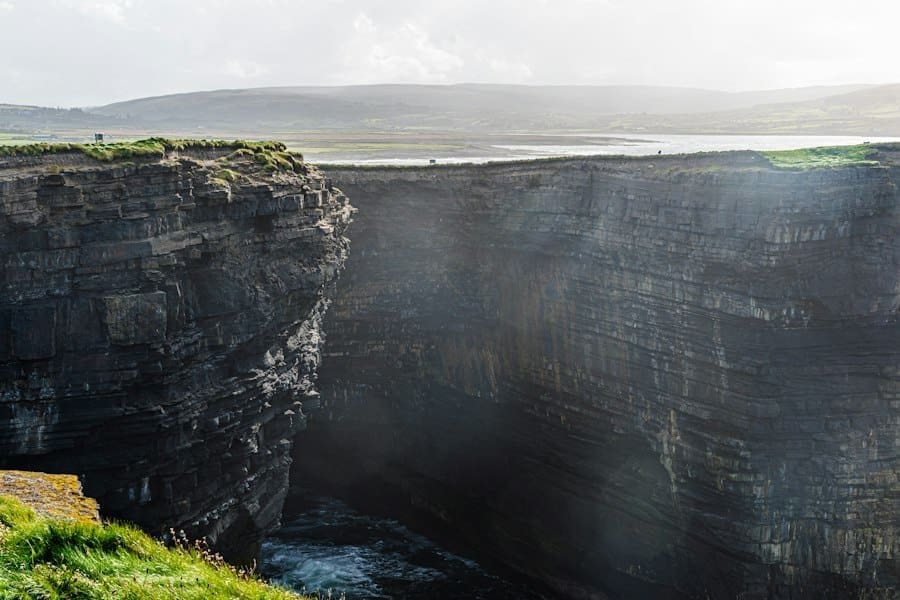
Beyond the immediate spectacle of Dún Briste, the entire coastline around Downpatrick Head is a geologist's dream, and even for a layperson like me, it was utterly fascinating. The cliffs themselves are a living textbook of geological processes, revealing layers of time and the immense forces that have shaped this land. I spent a considerable amount of time simply looking at the rock formations, trying to decipher the stories etched into their very fabric. The sheer variety of textures and colors, from dark, jagged basalt to lighter, more stratified limestone, was a visual feast. It made me feel like an amateur archaeologist, trying to piece together a narrative written in stone.
Layers of Time: Stratification and Erosion
The most striking geological feature, apart from Dún Briste itself, is the clear stratification of the cliffs. I could see distinct layers of rock, like pages in an ancient book, each representing a different epoch, a different environmental condition. Some layers were thick and robust, others finer and more delicate, all bearing witness to millions of years of sedimentation, uplift, and subsequent erosion.
It was a humbling experience to stand before such a vast timeline, to comprehend the immense stretches of time involved in their formation. The relentless assault of the Atlantic has carved out incredible formations – sea caves, arches, and blowholes – all testament to the ocean's sculpting power. I watched as waves crashed into the cliff face, sending spray high into the air, slowly but surely continuing the work of millennia.
The erosion wasn't just destructive; it was also creative, revealing the intricate internal structure of the earth. I noticed bands of chert and flint embedded within the limestone, harder materials that had resisted erosion more effectively, standing proud against the softer rock. This differential erosion created incredibly intricate patterns and textures along the cliff face. It was a dynamic landscape, constantly being shaped and reshaped, a living laboratory of geological processes unfolding before my eyes. I found myself drawn to the patterns, tracing the lines with my eyes, imagining the ancient seas that had deposited these sediments, the tectonic forces that had uplifted them, and the unceasing waves that now relentlessly carved them.
Prehistoric Evidence: Footprints and Fossils
While I didn't personally stumble upon any prehistoric footprints, the area around Downpatrick Head is renowned for its paleontological significance. I had read about the discovery of dinosaur footprints in nearby areas, particularly those of various theropods, and knowing this added another layer of wonder to my exploration. It connected me to an even deeper past, a time when these very cliffs might have been marshy land traversed by giant reptiles. Imagining such ancient creatures roaming where I now stood, felt incredibly surreal. The thought that their passage, millions of years ago, could still be observed today, was a profound testament to the enduring nature of geology and the fleeting nature of human existence.
I scoured the exposed rock faces, not necessarily expecting to find a dinosaur footprint myself, but with an enhanced awareness of the stories the rocks could tell. I did, however, find numerous smaller fossils embedded in some of the softer limestone – the remnants of ancient shells and marine organisms. These tiny relics, testament to a prehistoric seabed, were just as captivating in their own way.
Each fossil was a miniature portal to a forgotten world, a tangible link to life forms that existed millions of years ago. It reinforced the idea that this landscape wasn't just dramatic in its present form, but also a vibrant, ever-evolving chronicle of Earth's deep history, full of hidden treasures waiting to be discovered by the observant eye.
If you're looking for a collaborative writing platform, check out Chain Story Online. It's a great way to connect with other writers and create stories together. Many users have found inspiration and creativity through Chain Story Online.
Folklore and Legends: Whispers in the Wind
As I explored Downpatrick Head, the raw beauty of the landscape was continually interwoven with the rich tapestry of Irish folklore. The wildness of the place, its isolation and dramatic features, lend themselves perfectly to tales of ancient heroes, mythical creatures, and acts of divine intervention. It's impossible to stand on these cliffs, with the wind roaring and the sea churning, and not feel the echoes of these stories in the very air. I found myself imagining the ancient people who lived here, how they would have interpreted the natural phenomena around them, and how these powerful narratives would have shaped their understanding of the world. The landscape wasn't just rock and water; it was alive with myth and memory.
The Legend of St. Patrick and the Heathen Chief
The most prominent local legend, and one I found particularly compelling, centers around St. Patrick and a local pagan chief. The story recounts how a powerful chieftain, Croman Dubh (the Black Crooked One), refused to convert to Christianity. In a fit of anger and defiance, he tried to kidnap St. Patrick during a service. Patrick, in response to this sacrilege and an act of divine intervention, struck the ground with his crozier, causing the ground beneath Croman Dubh and his followers to separate from the mainland, forming Dún Briste. This dramatic severance left the chieftain and his people stranded on the new sea stack, eternally cut off from the land.
This powerful narrative explained the very existence of Dún Briste, offering a compelling human story for its geological formation. I stood there, looking out at the isolated stack, and could almost hear the cries of the chieftain and his doomed followers. The legend serves not only as an origin story for the sea stack but also as a powerful testament to the triumph of Christianity over paganism, a recurring theme in Irish hagiography. It transforms a geological marvel into a moral fable, deeply embedding human drama into the very fabric of the landscape. It added a layer of human suffering and divine power to the already awe-inspiring natural spectacle, making my experience even richer.
Giants, Fairies, and the Unseen World
Beyond St. Patrick, the vastness and wildness of North Mayo are fertile ground for tales of giants, fairies, and other mythical beings. While Downpatrick Head doesn't have a single dominant fairy tale associated directly with Dún Briste, the general atmosphere of the area absolutely lends itself to belief in the unseen world. The constant roar of the ocean, the sudden mists that can roll in, and the isolated nature of the cliffs easily conjure images of hidden creatures and ancient magic. I found myself scanning the horizon not just for birds, but almost instinctively, for something more, something otherworldly.
I mused on the stories of the Sídhe (fairies) inhabiting ancient burial mounds and remote natural features. While not explicitly mentioned for Dún Briste, the idea of these powerful, ethereal beings having dominion over such wild places felt entirely appropriate. The landscape felt alive, imbued with a spirit that transcended mere geology.
It reminded me of the enduring human need to create narratives, to explain the inexplicable, and to imbue the natural world with meaning and wonder. As I gazed at the turbulent waters around the stack, I could easily imagine a giant's hand having carved it, or mischievous fairies playing tricks on unwary travelers. These whispered legends, woven into the very fabric of the place, enhanced my sense of wonder and connection to this ancient, magical land.
Downpatrick Head and Dún Briste are remarkable destinations that showcase the stunning natural beauty of North Mayo, but for those interested in exploring more about this captivating region, a related article can provide additional insights. You can discover more about the area's rich history and breathtaking landscapes in this informative piece. For further reading, check out the article on Enda Storrie's website, which delves into the cultural significance and geological wonders of this enchanting part of Ireland.
Preserving the Wildness: Responsible Exploration
My visit to Downpatrick Head and Dún Briste was an undeniably profound experience, and it solidified my belief in the crucial importance of responsible tourism. Such natural wonders are not merely attractions; they are fragile ecosystems and irreplaceable historical landscapes that demand our respect and protection. I felt a strong personal responsibility to ensure that my presence did not diminish the very beauty I had come to admire, and I believe everyone who visits should adopt a similar mindset. The wildness of this place is its greatest asset, and it's up to us to preserve that for future generations.
Treading Lightly: Minimizing Environmental Impact
Minimizing my environmental impact was paramount. I stayed on designated paths, resisted the urge to venture too close to precarious cliff edges, and absolutely made sure to leave no trace of my visit. This meant packing out everything I brought in, including any food wrappers or water bottles. The delicate clifftop vegetation, adapted to harsh conditions, is easily damaged by trampling, and I was mindful of this with every step. I observed the abundant birdlife from a distance, refraining from any actions that might disturb their nesting sites or feeding patterns. The air was clean, the ground relatively unspoiled, and I wanted it to remain that way.
I also considered my photographic pursuits. While I wanted to capture the beauty, I did so without disturbing the environment or any wildlife. Flash photography near sensitive species can be disruptive, and drone usage, while offering unique perspectives, can also create noise pollution and disturb nesting birds. I made a conscious effort to be a silent observer, letting the landscape speak for itself, and capturing its essence through respectful and non-intrusive means. Responsible exploration is not just about following rules; it's about fostering an attitude of care and custodianship towards these precious natural spaces.
Supporting Local: Sustaining the Community
My approach to responsible tourism also extended to supporting the local community. Downpatrick Head is a popular destination, but it is situated in a relatively remote area. By purchasing refreshments or souvenirs from local businesses in nearby towns, I felt I was contributing directly to the livelihoods of the people who call this magnificent region home. This helps to ensure that tourism benefits the community, making it a sustainable and mutually beneficial relationship. It's a small way to give back to the place that offered me such an incredible experience.
Furthermore, I engaged with locals whenever possible, asking questions about the history, folklore, and best practices for visiting the area. Their insights not only enriched my understanding of Downpatrick Head but also helped me to be a more informed and respectful visitor. Local knowledge is an invaluable resource, and engaging with those who live and work in the area fosters a deeper appreciation for the cultural and environmental nuances of the destination. My journey to Downpatrick Head and Dún Briste was more than just a sightseeing trip; it was an immersive experience that underscored the importance of cherishing and protecting our planet's most extraordinary places. I left feeling invigorated, humbled, and deeply committed to responsible travel.
Related reading: Céide Fields: Exploring Ireland's Stone Age Landscape · Mythical Places in the West of Ireland: Where Legends Live
Enda Storrie is a writer and the creator of Story Bible, the planning journal and app for writers, and Chain Story Online, a free collaborative storytelling platform.

